

Professional Clothing Printing: The Ultimate Guide for Irish Clubs and Organisations
What if the most expensive mistake your club makes this season isn't a tactical one, but a choice in apparel printing that peels off before the first winter training session? You've likely seen it happen. A crest that cracks or a sponsor's specific brand colours that don't quite match the club's identity after a few heavy matches in the Irish rain. It's a common frustration that undermines the pride your players feel when they pull on their jerseys.
As an Irish-owned partner, we understand that your kit is a symbol of your community. This guide dives into the technical secrets of high-performance branding, ensuring your bespoke gear survives both the tackle and the wash. With the Irish clothing manufacturing industry growing at a compound annual rate of 13% through 2025, there's never been a better time to invest in premium quality. Discover how to build a professional kit that stays match-ready all season long.
Key Takeaways
- Learn why sublimation is the gold standard for high-contact sports like Rugby and LGFA to ensure zero-fade performance.
- Master the technical differences between traditional embroidery and high-performance apparel printing to match your branding to specific fabric weights.
- Discover how to organise multiple sponsor logos whilst staying compliant with official LGFA jersey regulations.
- Tackle the unique challenges of branding waterproof gear like dry robes and windcheaters without compromising their weather-resistant properties.
- Simplify your kit-out process with bespoke Irish solutions and 'All-Star' value packs designed for local clubs and organisations.
Table of Contents
-
Why Professional Apparel Printing is Vital for Club Identity
-
Mastering the Tech: Sublimation, Embroidery, and Screen Printing
Why Professional Apparel Printing is Vital for Club Identity
Confidence on the pitch starts long before the whistle blows. When a player pulls on a high-performance jersey, the quality of the kit sends a direct message about the club's standards. This psychological link is powerful. A crisp, bespoke kit instils a sense of elite professionalism that drives team performance. Conversely, a kit with a cracked crest or a peeling sponsor logo suggests a lack of discipline. Investing in professional apparel printing ensures your visual identity matches your athletic ambition.
Generic printing often fails the rigorous durability tests of Irish contact sports. In a heavy rugby tackle or a high-intensity LGFA match, the fabric is stretched and dragged through the mud. Standard retail-grade prints simply can't cope with this level of physical demand. By establishing a consistent brand identity across jerseys, hoodies, and outerwear, you create a unified front. With the Irish clothing manufacturing sector growing at a compound annual rate of 13% through 2025, clubs are increasingly moving away from basic merchandise toward 'official club gear'. Official gear is engineered for the field; it's a tool for peak performance, not just a souvenir.
The Pitfalls of Low-Quality Performance Branding
Cheap heat-press vinyl is a common trap for clubs looking to save a few Euro. However, these thick layers often peel or crack after just three washes in an Irish winter. Beyond aesthetics, there's a technical cost to poor branding. Large, heavy prints act as a barrier to moisture-wicking fabrics, trapping heat and hindering an athlete's thermoregulation. If the fabric can't breathe, the player overheats. Poor colour matching can also dilute your club's historic identity. If your traditional 'County Blue' looks purple on a rain jacket, your brand loses its authority.
Building Trust Through High-End Craftsmanship
Bespoke designs outperform off-the-shelf templates because they're built for your specific requirements. Understanding different printing methods allows you to choose the right tech for the right garment. For prestigious club crests, premium embroidery remains the gold standard, offering a tactile, high-value feel that lasts for years. This attention to detail also protects your revenue. Sponsors expect their branding to remain vibrant and intact. When you deliver a kit where their logo stays sharp through every match, you build the trust necessary for long-term financial support. Professional apparel printing isn't just a cost. It's a strategic investment in your club's future.
Mastering the Tech: Sublimation, Embroidery, and Screen Printing
Choosing the right branding method is a technical decision that dictates how your kit performs under pressure. It's not just about aesthetics; it's about engineering. Different fabrics require specific treatments to maintain their integrity, breathability, and professional finish. Whilst a local summer camp might prioritse cost-effective bulk orders, a senior LGFA or Rugby squad needs gear that survives the physical demands of a 70-minute match. Understanding the mechanics of apparel printing allows your club to make informed investments that last multiple seasons.
Sublimation: The Gold Standard for Sports Jerseys
Sublimation is a chemical process where heat and pressure turn solid ink into a gas that permeates the fabric fibres directly. Because the pigment becomes part of the material rather than sitting on top, sublimated kits never crack, peel, or fade. You could wash a sublimated jersey 100 times in harsh Irish conditions and the colours would remain as vibrant as the day they left the factory. This method offers total design freedom. You can incorporate intricate gradients, unlimited sponsor logos, and bespoke patterns across the entire garment without adding a single gram of weight or compromising the fabric's moisture-wicking properties.
Embroidery vs. Print: Which is Right for You?
Embroidery provides a traditional, high-value feel that signifies prestige. It's the preferred choice for heavy-duty garments like softshell jackets, gilets, and hoodies where the fabric weight (often exceeding 280 GSM) can support the tension of the stitches. However, on lightweight performance jerseys, large embroidered crests can feel heavy or abrasive against the skin. For these items, a high-definition print or sublimation is often superior. When balancing your budget, consider that embroidery costs are usually driven by stitch count. A complex crest with 15,000 stitches requires more machine time than a simple text logo. For clubs looking to maximise their impact, our bespoke design service can help you strike the perfect balance between stitched elegance and printed performance.
For high-volume requirements, such as event tees or youth training bibs, screen printing remains a dominant force. In fact, industry data from 2024 shows screen printing still accounts for 52.8% of the custom printing market due to its efficiency in large runs. It's a reliable, cost-effective way to produce hundreds of items quickly. Conversely, heat transfer is the most versatile option for individual names and numbers on pre-made garments. It allows for rapid personalisation without the setup times required for screens or embroidery digitisation. By matching the technology to the garment's purpose, you ensure your club always looks like a professional outfit.
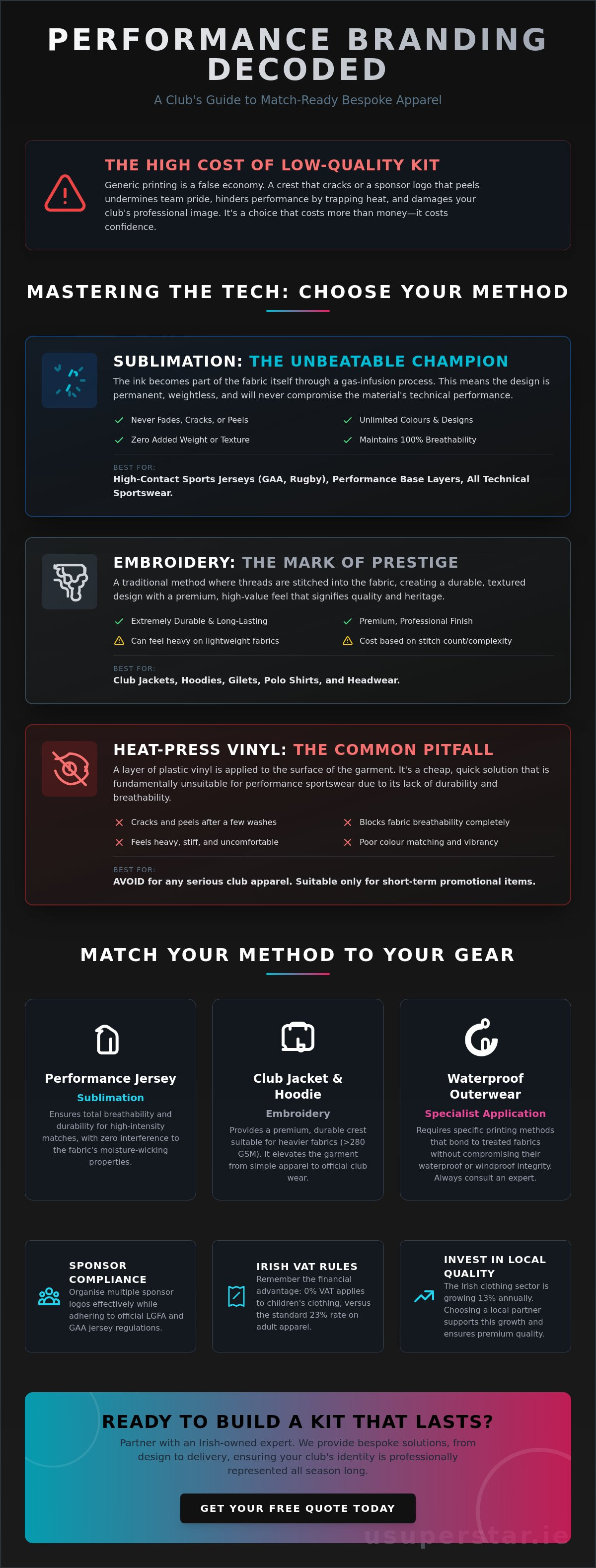
Choosing the Right Printing Method for Performance Fabrics
Selecting the right branding technique requires a deep understanding of fabric weights, measured in Grams per Square Metre (GSM). A lightweight 140 GSM performance jersey reacts differently to heat and pressure than a heavy 330 GSM cotton-rich hoodie. For 100% polyester garments, we must manage the risk of dye migration, where the fabric's colour bleeds into the print. This is why specialised apparel printing barrier inks are essential for maintaining crisp whites on navy or bottle green kits. Without these technical safeguards, your sponsor's logo will quickly lose its visual impact.
Waterproof outerwear, such as windcheaters and the increasingly popular dry robes, presents a unique challenge. Standard embroidery creates thousands of tiny needle holes that can compromise a garment's water resistance. In these cases, we often recommend high-bond heat transfers or specific sealing techniques that maintain the jacket's integrity whilst showcasing your club's crest. For high-movement sports like basketball or volleyball, the print must possess high elasticity. If the branding doesn't match the fabric's stretch and recovery, you'll see 'ghosting' or cracking as the athlete moves on the court.
Technical Fabrics and Ink Adhesion
High-performance moisture-wicking fabrics are designed to move sweat away from the body. If you cover a jersey in a thick, plastic-feeling print, you effectively 'cap' the fabric, destroying its primary function. We prioritise a 'soft-hand' feel, using inks that bond deeply with the fibres without blocking the weave. When embroidery is necessary on thin technical materials, we use specialised stabilising backings to prevent the fabric from puckering or tearing during high-intensity play. This ensures the garment remains comfortable throughout a full match.
Durability Testing for the Irish Climate
The Irish weather is famously unpredictable, swinging from intense UV exposure to damp, freezing conditions in a single afternoon. Our apparel printing processes use UV-resistant pigments to ensure your club colours don't fade during those rare sunny summer tournaments. Flexibility is just as vital. Prints that become brittle in the cold will snap when the fabric flexes. By using premium, polymer-based inks, we ensure your branding remains supple and intact whether you're playing in a coastal gale or a mid-winter downpour. This commitment to longevity is a hallmark of our Irish-owned manufacturing standard.
Organising Your Club Branding: Design, Sponsors, and Logos
A professional jersey is more than a uniform; it's a strategic asset for your club's financial health. Effectively managing sponsor visibility whilst maintaining your club's heritage requires a careful balance. If a design is too cluttered, the primary sponsor's message is lost. If it's too sparse, you miss opportunities to reward local businesses for their support. Expert apparel printing involves more than just sticking a logo on a shirt; it's about engineering a layout that respects official regulations and looks elite on the field.
For Irish clubs, navigating official branding rules is essential. The GAA and LGFA have specific guidelines regarding the size and placement of sponsor logos to ensure they don't interfere with the club crest or player numbers. For example, a primary sponsor usually occupies the chest area, but there are strict dimensions to follow to remain compliant for televised matches or official tournaments. Balancing these requirements with your club's traditional colours ensures a cohesive look that players wear with pride. We recommend using vector files (such as PDF or EPS) for all branding. Unlike standard JPEGs, vector files can be scaled to any size without losing sharpness, which is the secret to crisp, professional-grade results.
The Anatomy of a Professional Jersey Design
Primary sponsor placement is your most valuable real estate. It should be centred and sized to maximise visibility from the sidelines. Player numbers and names must use high-contrast colours to ensure easy identification for referees and spectators. Secondary logos, such as those for local coffee shops or physiotherapists, are best placed on the sleeves or the nape of the neck. This hierarchy of information keeps the kit looking organised rather than chaotic. When moving to embroidery for club crests, remember that a one-time digitisation fee of approximately €20 to €50 usually applies to convert your artwork into a machine-readable format.
Streamlining the Design Process
Collecting high-resolution logos from multiple local sponsors can be a logistical headache for club volunteers. We often see rough sketches or low-quality screenshots that won't survive the apparel printing process. This is where our 'Professional Teammate' approach makes a difference. Our team takes your rough ideas and sponsor files to create production-ready designs that meet every technical standard. We handle the transition from a basic concept to a bespoke, high-performance kit, removing the creative burden from your committee. If you're ready to see your vision come to life, enquire about our free design service today.
To ensure your kit looks its best, always ask your sponsors for their 'brand guidelines' or 'vector logos'. Providing these early in the process prevents delays and ensures that the final product matches their exact corporate colours. By organising your branding early, you can focus on what matters most: the performance of your team on match day.
The sUperstar Advantage: Bespoke Irish Apparel Solutions
Choosing a partner for your club's kit is a decision that impacts your community for years. Being an Irish-owned specialist means we understand the unique pressures of the local sporting landscape. We aren't just a vendor; we're a professional teammate. Our approach to apparel printing and garment construction is rooted in the physical demands of Irish sport, from the rain-soaked sidelines of a January morning to the high-stakes atmosphere of a summer final. We prioritise high-performance results because we know your gear represents your club's history and its future.
To support organisations of all sizes, we developed our 'All-Star' value packs. These bundles provide a complete kit-out solution that ensures every member, from the senior squad to the youth academy, looks uniform and professional. By consolidating your requirements, you benefit from consistent branding across different fabric types whilst staying within your committee's budget. This streamlined approach removes the guesswork and ensures that every item meets our premium quality standards before it reaches your clubhouse.
Bespoke Manufacturing vs. Off-the-Shelf
Many competitors rely on 'off-the-shelf' generic blanks that are simply decorated after the fact. We take a different path. Our gear is custom-manufactured from scratch, allowing for a level of fit and performance that generic items can't match. When a garment is built for your organisation, the panels are cut to optimise movement for athletes. The apparel printing is integrated into the manufacturing flow, ensuring that logos and crests are positioned with mathematical precision. There's a tangible pride in wearing gear designed specifically for your team. It's a bespoke suit for the pitch, engineered to survive the tackle and the wash. This sense of pride often extends to supporters and families during club social gatherings; for those interested in matching themed clothing for special group events, you can find out more about coordinating custom options.
Getting Started with Your Club’s New Look
We know that club volunteers are often overstretched. To simplify the process, we offer a dedicated club shop service. This allows members to order their own gear directly, removing the burden of collecting money and sizes from the committee. From the moment you provide an initial design concept, our team works to a disciplined timeline to ensure your kit is ready for the new season. We provide a free design service to translate your vision into a production-ready reality, ensuring every technical detail is perfect. If you want to elevate your organisation's identity, it's time to Get More Cheer for Your Gear with sUperstar’s bespoke services. Our commitment to high-end production and local reliability makes us the elite choice for Irish clubs.
Step Onto the Pitch with Professional Pride
Your team's visual identity is the first thing opponents see and the last thing your sponsors remember. By mastering technical processes like sublimation and ensuring your branding meets official LGFA and GAA regulations, you're building a foundation for long-term success. High-quality apparel printing isn't just a decoration; it's a commitment to your players' pride and comfort on the pitch. Choosing bespoke, custom-manufactured gear over generic alternatives ensures your kit survives the physical demands of Irish sport whilst looking elite. Every stitched crest and sublimated sponsor logo acts as a testament to your club's professional standards.
As an Irish-owned and operated specialist and an LGFA Official Licensee, sUperstar acts as your professional teammate. We combine technical manufacturing expertise with a genuine passion for local sports culture to deliver premium, custom-manufactured quality that lasts. Don't let low-quality prints or peeling logos undermine your club's hard-earned reputation. It's time to design your bespoke club kit with sUperstar's free design service. We'll help you translate your vision into a high-performance reality that instils confidence from the first whistle to the final score.
Frequently Asked Questions
What is the best printing method for sports jerseys that need to be washed frequently?
Sublimation is the superior choice for jerseys requiring high-frequency washing. Unlike surface-level prints, the ink chemically bonds with the fabric fibres during the manufacturing process. This ensures your apparel printing remains vibrant and crack-free even after 100 industrial wash cycles. It's the standard for senior squads who need their kits to look pristine every week throughout a long season in the Irish climate.
Can I include multiple sponsor logos on my club's apparel printing order?
You can absolutely include multiple sponsor logos on your bespoke kit. Sublimation allows you to add as many logos as required at no extra cost, as the entire design is printed into the fabric panels simultaneously. We'll help you arrange these in accordance with official LGFA and GAA regulations. This ensures your kit remains compliant whilst giving every local business sponsor the visibility they deserve.
Is there a minimum order quantity for bespoke club kits?
Minimum order quantities typically start at 10 to 15 units for bespoke, custom-manufactured kits. This allows us to maintain the high standards of production required for professional-grade gear. For smaller groups or top-up orders, our 'All-Star' value packs or dedicated club shops often provide more flexible solutions. This ensures even the smallest organisations can access premium quality without carrying excessive stock or overheads.
How do I ensure our club's colours are matched exactly in the printing process?
We use the Pantone Matching System (PMS) to ensure your club's colours are replicated with total accuracy. If your club has a specific historic shade, providing the Pantone reference allows our apparel printing team to match it exactly across different garments. This prevents the common issue of your match jerseys appearing a different shade of blue than your training hoodies or softshell jackets.
What file format do I need to provide for our club crest and sponsor logos?
Vector files, specifically in PDF, EPS, or AI formats, are essential for achieving a sharp, professional finish. These files allow us to scale your crest and sponsor logos to any size without any pixelation or loss of detail. If you only have low-resolution JPEGs, our design team can often redraw them for a fee to ensure they meet our production-ready manufacturing standards.
How long does the design and printing process usually take for a full team kit?
The process from initial design approval to final delivery usually takes between 4 and 6 weeks. This timeline includes the bespoke manufacturing of your garments and the precision application of all branding. We recommend starting your design journey at least two months before your first match. This allows ample time for sizing checks and committee approvals during the busy pre-season period.
Can you print individual player names and numbers on hoodies and jerseys?
Yes, we can easily add individual player names and numbers to your jerseys and hoodies. For sublimated jerseys, these are integrated directly into the fabric design for zero added weight or stiffness. For pre-made items like hoodies, we use high-performance heat transfers. This personalisation is a great way to boost player morale and simplify kit management during training and match days.
What is the difference between sublimation and traditional heat transfer printing?
Sublimation turns ink into a gas that permeates the fabric, whilst heat transfer involves pressing a vinyl or film onto the surface. Sublimation is limited to polyester-rich fabrics but offers zero-fade durability. Heat transfer is more versatile for cotton-rich school hoodies or adding names to stock items. Choosing between them depends on your specific performance requirements and the base material of your chosen garment.